/
Trend: Haute Table
Long before porcelain appeared on European dining tables, Chinese craftsmen had mastered its production. Jingdezhen, in China’s Jiangxi province, became an important centre of porcelain production during the Song dynasty, later supplying the imperial court and international markets. The English word china, still used for fine porcelain and tableware, recalls its origins. Japanese porcelain, particularly from Arita, also became highly sought after in Europe. The arrival of Chinese and Japanese porcelain caused a sensation in Europe, where makers began experimenting with their own versions. In the early eighteenth century, Meissen in Germany became the first European producer of hard-paste porcelain. French manufactories such as Sèvres and, later, porcelain houses in Limoges developed their own styles. In the Netherlands, Delft became famous for its blue-and-white earthenware, inspired by imported Chinese porcelain.
Today, that fascination with ceramics continues. Pottery classes attract enthusiasts keen to work with their hands, while the success of the British television series The Great Pottery Throw Down has brought the craft to a wider audience. Shaping an object by hand takes skill, artistry and patience, and even small irregularities can give a piece its character. Dutch ceramics studio Cor Unum collaborates with designers and artists, experimenting with form, colour and decoration. Alongside these contemporary interpretations, historic porcelain houses continue to produce tableware, while fashion houses such as Dior and Hermès have developed their own porcelain collections.
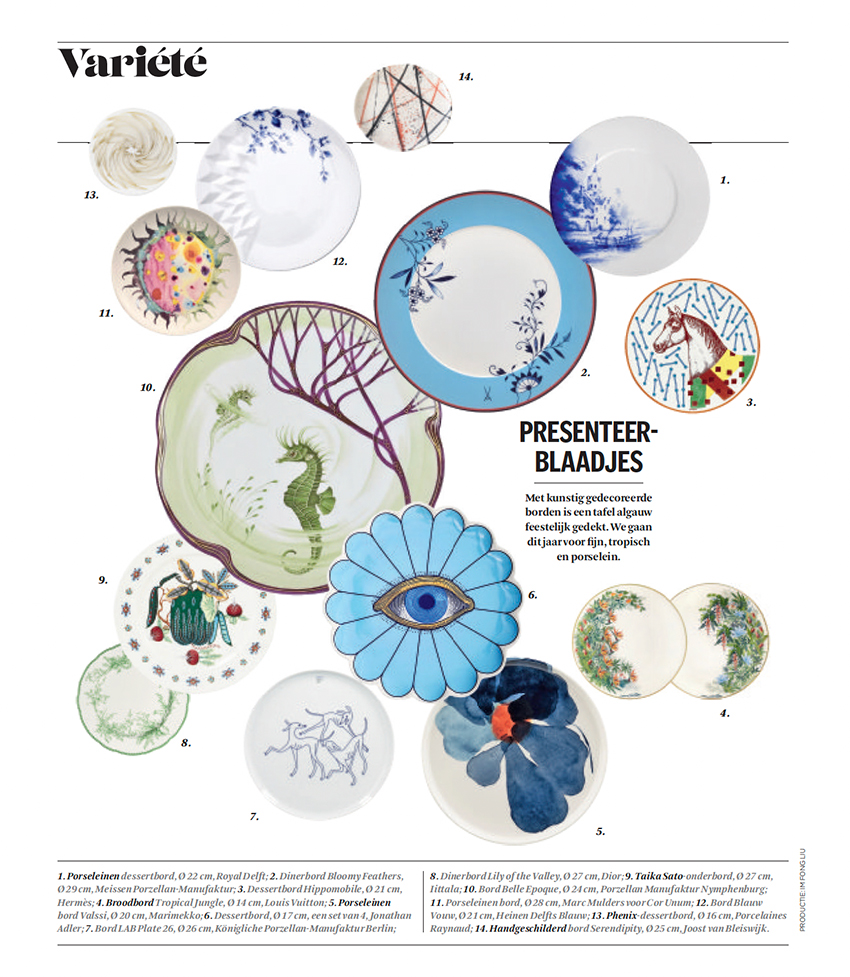
From delicate florals and traditional blue-and-white patterns to surrealist motifs and bold illustrations, a plate can be as interesting as the food served on it. For FD Persoonlijk, I selected fourteen designs that deserve a closer look, even before dinner is served.
Fashion edit and composition by Im Fong Liu for FD Persoonlijk
Images courtesy of the brands